
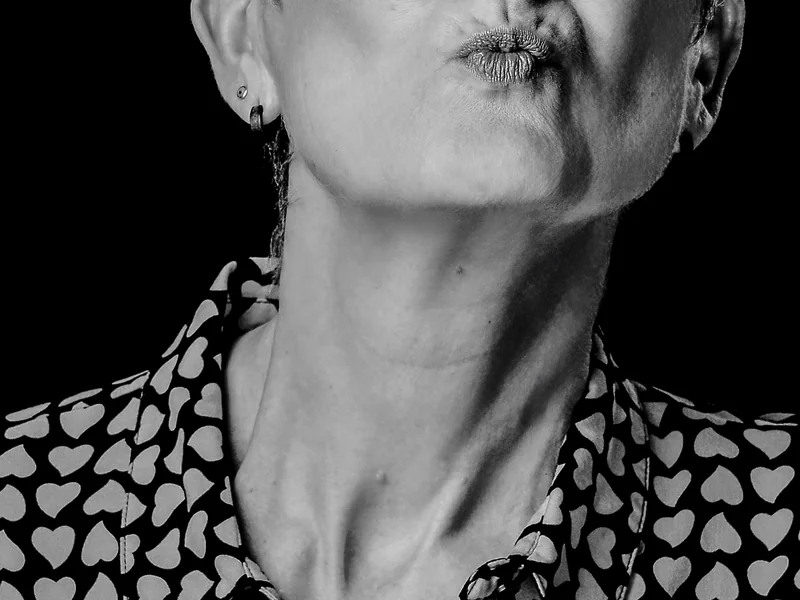
A portrait can have an immediate effect. A gaze, a posture, or a specific light draws attention. A story quickly emerges while viewing: this person seems strong, sad, open, or reserved. Such impressions are part of the encounter with images. However, they are not automatically knowledge about the person. A portrait shows a person in a photographically composed situation. It does not tell their whole life story by itself.
Distinguishing between observation and interpretation
A face is turned toward the camera, the hands are resting calmly, the background is dark. These are describable features of a shot. The statement that the person is therefore particularly thoughtful or has experienced a lot goes beyond that. It interprets the image and attributes something to the person.
This distinction does not make descriptions impersonal. It makes them more precise. We can say that a shot has a calm effect on us without deriving a fixed character trait from it. An image may trigger an impression, and at the same time, it may remain open whether the person photographed experiences themselves in the same way.
Especially with portraits, this openness is important. Light, framing, and the selected moment significantly influence the depiction. A different expression from the same session could evoke a completely different impression. No single shot can definitively determine all sides of a person.
Not every strong visual effect needs a strong story
A dark portrait does not become more significant if a story of suffering or overcoming is added to it. A laughing picture does not have to prove personal success. Such narratives can draw attention to an interpretation that is not even aligned with the person.
It is worth giving a shot some space first. What does it carry itself: the gaze, the proximity, the relationship between several people? Perhaps this context is enough. A supplementary explanation should contribute something actually known and not just increase the effect.
In the editorial on Craft, Attitude, and Encounter it is about how photographic means and the interaction with people come together. Care is shown not only in the lighting setup, but also in the words that later stand next to an image.
The perspective of the person photographed counts
A shot that outsiders find particularly impressive does not have to be the one the person identifies with most. Perhaps they find the expression alien or want to present themselves differently for the intended purpose. This should not be dismissed as a lack of understanding of photography.
Concrete questions help with the selection: Does the representation match your wish? Would you like to introduce yourself with this picture? Which effect feels consistent and which does not? Personal feedback does not have to be a technical analysis to be relevant.
At the same time, an unfamiliar perspective can be interesting. The person is allowed to discover it without having to immediately reject or accept it. It is important that the decision is not determined solely by the effect on others. A portrait is not a competition to see who recognizes the most convincing story in it.
Do not measure family photos against an ideal
With group photos, expectations of closeness and togetherness are quickly projected onto people. Everyone is supposed to smile, touch each other, and show the same openness. But families express connection differently. A quiet side-by-side can be just as fitting as an embrace.
If not everyone wants to be photographed, a joint decision on the framework is needed. The desire for a valuable picture does not justify crossing boundaries. The later use should also be discussed. A picture for the family is a different context than a public presentation.
Photography can make relationships visible without explaining them. A small gesture or a familiar distance can have meaning for those involved that outsiders do not fully know. The picture does not need to translate this meaning publicly to be important.
Stay attentive in special project contexts
In engagement projects, a personal background is often already known. Especially then, it should not determine the entire perception of the person. A human being is more than an illness, a phase of life, or the occasion for which a portrait was created.
For unSICHTBAR this perspective is particularly important to me: It is about the human being. The project description provides the framework, but does not dictate what each individual person must feel or show in their picture. A photograph can be experienced differently.
Therefore, known information should not be automatically included in every caption. What is supposed to be told for a specific use must be clarified. This thought describes editorial and photographic care; specific rights and clearances must also be checked separately.
Describe what helps understanding
A good caption can mention names, the occasion, or a relevant context, provided this information is intended and verified. It does not need to repeat every visible detail. Likewise, it should not claim qualities that are not evident from the photograph alone.
For a factual description, lighting, posture, surroundings, or the recognizable arrangement of multiple people are helpful. What relationship they actually have should only be stated if it is known. The fact that people in a picture look similar, for example, is not enough to claim a family relationship.
Restraint means precision here. It lets the image speak and provides just enough information as makes sense for the context. A string of big words about strength, authenticity, and emotion, on the other hand, does not automatically make a description more human.
Openness as part of photographic quality
I want to make people visible, not provide a definitive explanation of their person. This involves carefully composing images and speaking about them just as carefully. The photograph may show something and leave other things open. This boundary does not strip it of any meaning.
You can find more about my journey and my way of working at Anne Simon. When you look at portraits, you can ask yourself: What am I actually seeing, and what am I adding in my thoughts? This small distinction creates space for a closer look – at the image and at the person behind it.
To the journal overview