
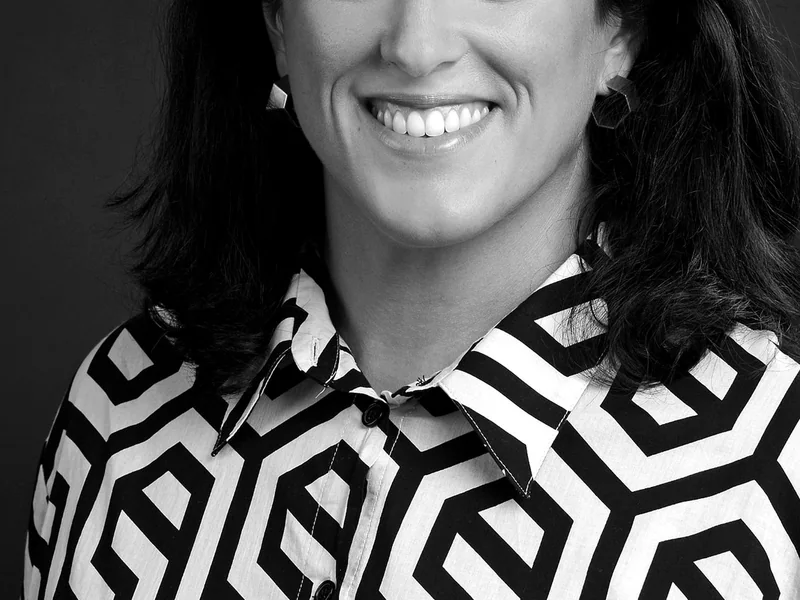
The right clothing for a business portrait cannot be answered with "always a suit" or "as casual as possible". It should suit you, your professional role, and its later use. A portrait introduces a person, not a general concept of professionalism. Therefore, the actual working context is the better starting point: How do you interact with clients, business partners, or new employees, and what representation would be credible in that process?
Starting from everyday professional life
Think about what clothing would be appropriate for an important, but normal professional contact. Neither the most festive occasion nor the most casual moment should set the standard. What is needed is a setting in which you move naturally and at the same time present yourself as you want to appear professionally.
The answer can vary depending on the role. A consulting job, craft work, and artistic independence do not have to have the same wardrobe. Even within an industry, there is no single right combination. A rigid image of what competence should look like is of little help in the selection process.
Clothing can provide orientation, but it cannot prove professional qualification. The portrait should therefore not attempt to invent a role through accessories or particularly formal pieces. It can be carefully styled and still remain close to your actual appearance.
Consider the corporate identity as well
If the picture is going to be part of a team page, the overall impact is part of the decision. Is there already a visual style? Do colleagues tend to wear formal or casual clothing? Are certain corporate colors intentionally planned? Such questions should be clarified before each person selects for themselves.
A shared direction needs some leeway. Different people are allowed to wear different cuts and garments. What matters is not complete uniformity, but a comprehensible connection. If everyone interprets the same guideline differently, a concrete description helps more than another abstract term like "smart" or "modern".
For freelancers, personal positioning is more in the foreground. Here too, the clothing should match what visitors will later see on website and professional profile see. A deliberately very formal portrait can have a different effect than the other images and texts. Check whether this difference is intended.
Assess clothing and background together
A dark top against a dark background places different demands on the lighting than the same clothing against a bright surface. A bold color can create deliberate emphasis, while a striking pattern strongly draws the eye. Therefore, an outfit cannot be definitively evaluated independently of the planned shot.
In a picture taken in the work environment, existing colors, materials, and objects come into play. Against a minimalist background, the clothing may take on more weight. Having a neutral alternative on hand can provide flexibility. It is not necessary to generally avoid every bold color.
Large lettering and very prominent logos should match the intended use. A garment that clearly references another brand can create an unintended focus. Corporate clothing, on the other hand, may be exactly what is desired. The question is always: Does this detail support the message of the image?
Check the fit practically before the appointment
Try on the complete combination, not just a single top. Sit down, stand up, and move your arms. Does the collar stay where it is supposed to? Does the clothing feel tight in a normal posture? Do you constantly have to adjust something? An outfit that only works in one position can be a needless distraction during the shoot.
Glasses and jewelry may naturally be included. When it comes to accessories, consider whether you actually wear them in your professional everyday life and whether they fit the desired visual impact. A portrait does not become more professional just because as many signs of a professional role as possible are visible.
If shoes might be visible in the planned crops, include them in your selection. For a tight portrait, they are less relevant compositionally than for a wider shot. Which variants are needed should be determined by the image requirements and not happen by chance during the appointment.
Work with a few meaningful variants
If you are hesitating between two directions, a limited selection can help. For example, you can consider a combination with and without an additional jacket, as long as both fit your role. The change should serve a purpose and not just increase the number of different images.
Discuss such variants in advance. Several complete wardrobe changes affect the schedule and are part of the agreed scope. A small, well-chosen selection is often clearer than many similar pieces that have to be decided on again on-site.
For an application photo the focus is more strongly on the targeted professional environment. For business portraits, an existing corporate presentation may also be decisive. The topics overlap, but are not identical. Choose the orientation that fits your use case.
Do not let the person disappear behind the outfit
Clothing should support the capture. If you are thinking throughout the entire appointment about whether you are playing the right role in it, the selection may be too far removed from who you are. You are allowed to dress consciously without fundamentally reinventing yourself for the photo.
Even a simple appearance can be photographed clearly and with high quality. Light, posture, and framing contribute significantly to the effect. A more elaborate outfit does not replace this styling. Conversely, a personal style does not need to be toned down if it belongs to the professional context.
In the business planning guide find the connection to location, visual language, and usage. On the page for Business photography you can get to know the framework for your inquiry. In case of uncertainty, concrete pictures of your intended combinations help. Then we talk about the actual outfit instead of a general idea of what business attire should look like.
To the journal overview